 11
11
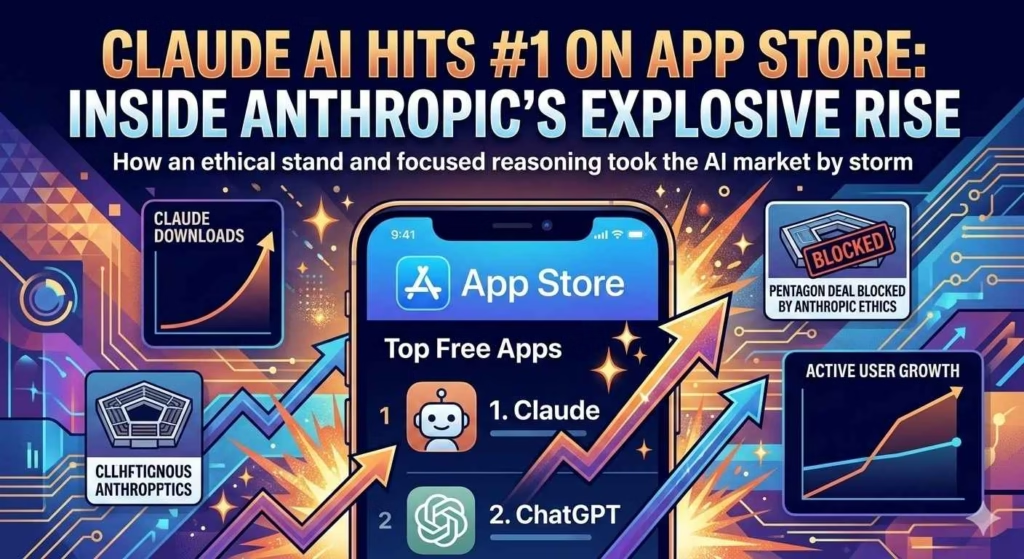
When I first downloaded Claude by Anthropic on the App Store, it was mid‑February 2026—the app ranked somewhere outside the top 20. Over the next ten days, it vaulted up the free‑app charts until, by March 1, it officially surpassed OpenAI’s ChatGPT to claim the No. 1 spot in the U.S. free apps category. That kind of acceleration is rare: in 2025, the highest‑downloaded generative AI app (OpenAI’s ChatGPT) only topped the charts with an extended marketing push and mainstream adoption—but not amidst controversy.
Smartphone app rankings have real implications. Apple’s marketplace still drives millions of first-time downloads daily; back in 2025, analytics firms estimated the App Store had over 2 million active apps with hundreds of thousands added each year—and only a tiny fraction ever crack the top 100.
The spike with Claude wasn’t just noise. Data from Sensor Tower shows a rapid climb: outside the top 100 in late January → top 20 through mid-February → top 5 by February end → No. 1 by early March.
Here’s how this compares with broader AI app adoption:
Claude’s meteoric ranking wasn’t organic in the usual way (feature updates, targeted ads, sustained PR). It was fueled by a macro tech-world story involving a public dispute with the U.S. Department of Defense.
Anthropic reportedly refused to sign a Pentagon contract without strict safeguards against using its models for domestic surveillance and autonomous weapons deployment. In response, the Trump administration directed federal agencies to ban Anthropic products, branding the firm a “supply-chain threat.”
What followed was striking:
I remember checking the App Store rating early on—Claude sat at ~4.7 stars from 56,000+ ratings just before its jump to No. 1. Quite a lot of downloads were coming from real users giving substantive reviews rather than bots or shallow installs.
Beyond the headlines, Claude is competitive because it delivers utility. On the App Store listing, Anthropic emphasizes:
Large language models like Claude have been benchmarked across tasks such as reasoning and synthesis against peers. For example, independent reports indicate the underlying Claude models (Sonnet 4.5 and Opus 4.6) deliver top-tier scores on real-world coding and complex problem benchmarks—making them not just conversational toys but utility tools.
This broader context matters: many users adopting the app aren’t casual testers—they’re trying real workflows that require multi-step reasoning, coding support, or document analysis.
Even with Claude’s success, adoption isn’t friction-free. Here are common rookie mistakes I’ve seen firsthand—and why they hurt user experience:
1. Treating Claude as a generic chatbot
Many users expect it to mimic Google or old Siri functionality. Claude doesn’t search the web like a browser; it summarizes and reasons about input. Misunderstanding this leads to disappointment when users ask real-time weather or trending news without specifying context.
Consequence: Chaos in outputs, repetitive responses, or hallucinations perceived as “faults” rather than limitations of training data.
2. Ignoring API limits and token costs
Claude models operate with token budgeting and rate limits. I remember building a prototype prompt that asked for 1000 token story output—it timed out because I didn’t budget for it.
Consequence: Throttled sessions, unexpected errors, or truncated content.
3. Misconfiguring privacy and memory settings
New users often leave context logging on, assuming more history = better output. Instead, Claude can get bogged down with irrelevant context.
Consequence: Slower processing and off-topic responses.
4. Treating charts and analytics as authoritative vision
On Reddit and forums, you’ll see snapshots of rankings by country. Ranking #1 in one region doesn’t always reflect global usage or long-term usage retention.
Consequence: Misleading assumptions about product stability.
Many users report “Connection timeout / failed to generate response” errors when using Claude on mobile. Here’s a fast path to resolve it:
| Step | Action | Why It Works |
|---|---|---|
| 1. Force close the app & clear cache | iOS retains session tokens and stale cache can break API calls | Clears corrupt session state |
| 2. Toggle network (Wi-Fi ↔ cellular) | Some firewalls throttle API traffic to cloud hosts | Forces a fresh route to Anthropic servers |
| 3. Sign out and sign back in | Refreshes backend tokens tied to Apple account authentication | Resets session tokens and revalidates subscription |
If the issue persists, check Apple’s iOS version and Claude’s app version—mismatches between iOS and app updates sometimes trigger weird bugs.
No product is perfect, and the data says so. Independent safety and usability benchmarks show:
These are real users losing time and money. And while that doesn’t affect overall rankings immediately, negative sentiment can bite retention over months.
Claude’s rise to the top of Apple’s App Store in early 2026 represents a rare conflux of product strength, political narrative, and consumer passion. It’s not simply an algorithmic popularity bump; it’s a reflection of how AI ethics and societal debates intersect with technology adoption at scale.
Behind the headlines, the app does deliver serious functionality—beyond chatbot fluff—and people are voting with their thumbs by downloading, rating, and using it regularly.
For newcomers, remember: context matters. Set expectations right, understand the product’s strengths and limits, and use pragmatic troubleshooting when things go sideways. That’s the difference between a fleeting download and a tool that actually makes you more productive.